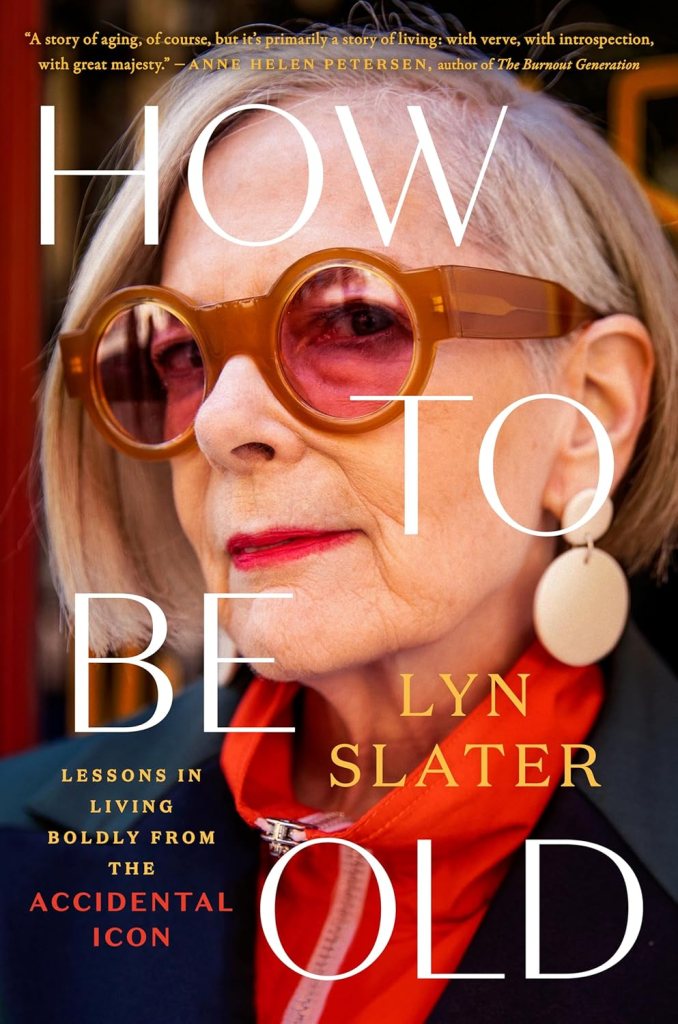
I stumbled upon How to be Old recently on the website where I buy most of my books. (Confession: because I am doing another master’s degree, I am buying a lot of books. Therefore, I’m logging in almost daily to my go-to site where I order books – either looking for school-related books, ordering books, and/or watch tracking of the books I’ve ordered. If you are interested in good book-buying resources, check out my book-resources blog post).
I don’t recall just now what type of book algorythm resulted in the book site suggesting How to be Old, but it proved to be one of those occasional books that I order on-the-spot and site-unseen. I’m now nearly half-way through the book and I’m glad to be reading the book. When I’m done reading it, the book has a permanent home on the “pop culture” section of my bookshelves (do you also have some kind of personalized dewey decimal system for organizing books on your bookshelves?). Lyn Slater – the author of How to be Old – uses fashion to express herself; my bookshelves are similarly a personal form of self-expression. When I moved last time, I told my realtor that “I need a residence that has enough wall space for my bookshelves.” When I have guests over, I – as a book afficianado – want my guests to see what types of books I read; my bookshelves give my guests insight into who-I-am-based-on-what-I-read (e-books are not for me!). Okay, this self-explanation/description is actually in keeping with the writing style used by Lyn Slater in writing How to be Old.
How to be Old is proving to be the feel-good book I was hoping for when I stumbled upon it. Lyn Slater, as she describes in her book, insists on being present in her own life. She is doing what she wants to do and insists on persuing her life without fear in a way that brings her value. She writes of all of this in her own style – a style that makes her perspective accessible. I was thrilled to discover in this book that she – like me – refuses to be afraid of the darker counters of society, choosing instead to go explore those contours (I grew up “on the margins” and then volunteered in the prison system for twenty years – she also “goes to the darker contours”).
This book is accesssible, readable, and is a pragmatic pick-me-up. stumbled upon How to be Old recently on the website where I buy most of my books. (Confession: because I am doing another master’s degree, I am buying a lot of books. Therefore, I’m logging in almost daily to my go-to site where I order books – either looking for school-related books, ordering books, and/or watch tracking of the books I’ve ordered. If you are interested in good book-buying resources, check out my book-resources blog post).
I don’t recall just now what type of book algorythm resulted in the book site suggesting How to be Old, but it proved to be one of those occasional books that I order on-the-spot and site-unseen. I’m now nearly half-way through the book and I’m glad to be reading the book. When I’m done reading it, the book has a permanent home on the “pop culture” section of my bookshelves (do you also have some kind of personalized dewey decimal system for organizing books on your bookshelves?). Lyn Slater – the author of How to be Old – uses fashion to express herself; my bookshelves are similarly a personal form of self-expression. When I moved last time, I told my realtor that “I need a residence that has enough wall space for my bookshelves.” When I have guests over, I – as a book afficianado – want my guests to see what types of books I read; my bookshelves give my guests insight into who-I-am-based-on-what-I-read (e-books are not for me!). Okay, this self-explanation/description is actually in keeping with the writing style used by Lyn Slater in writing How to be Old.
How to be Old is proving to be the feel-good book I was hoping for when I stumbled upon it. Lyn Slater, as she describes in her book, insists on being present in her own life. She is doing what she wants to do and insists on persuing her life without fear in a way that brings her value. She writes of all of this in her own style – a style that makes her perspective accessible. I was thrilled to discover in this book that she – like me – refuses to be afraid of the darker counters of society, choosing instead to go explore those contours (I grew up “on the margins” and then volunteered in the prison system for twenty years – she also “goes to the darker contours”).
Lyn Slater’s book is accessible, readable, practical. Hers is not a psycho-babble pick-me-up, but a pragmatic life-honestly-lived look at living well. If Anne Lamott were writing about being a fashion-blogger in New York who insists on navigating life in a personally meaningful way, this type of book (How to be Old) could possible be the result.
Bibliophile and would-be-antiquarian Kim Burkhardt reviews books at The Books of the Ages and at The Hermitage Within. If you are a new visitor, it would be great to have you follow this blog (thank you!). If you know someone who would like this blog, please share it with them (thank you!). FYI, you can $$ support this blog by clicking here here to do your Amazon shopping (if you click here before you start your Amazon shopping, Amazon pays us a commission when you shop via the link provided – thank you).
 The Books of the Ages