Book Review: “We the Women”

Book: We the Women

I am familiar with Norah O’Donnell from her role as a national newscaster.

I heard a radio interview several weeks ago in which Nora O’Donnell was talking about her new book titled We the Women: Hidden Heroes Who Shaped America. I was generally interested in the interview and the book for two reasons: I like Norah O’Donnell and I already have two other books on related topics. The two related books I have are Cokie Robert’s book Founding Mothers: The Women Who Raised Our Nations and Bonnie Angelo’s Fist Mothers: The Women Who Shaped the Presidents (I reviewed those two books here).

As I listed to Nora Roberts’ radio interview, I was hooked when she said that the printer who printed the U.S. Declaration of Independence was a woman – a woman who, as the printer, signed her name on the document. I wanted to know more about that woman. I ordered the book.

As I have started reading this book, I appreciate the tenacious research Nora O’Donnell – and, presumably, her co-author Kate Andersen Brower – did to find and learn about the women profiled in this book. I don’t recall hearing about these historical women in school (except Eleanor Roosevelt) – we likely didn’t hear about them. I was surprised to learn in the early part of the book that as our nation was heading toward the Revolution that we had a recognized black poet who compared Britain’s oppression of the colonies to slavery. I was surprised to learn that our first postmaster was an unmarried woman. Several of the signers of the Declaration of Independence knew – and interacted with – some of these women. I’m looking forward to more discoveries as I continue reading the book.

One of the noticeable structural features of We the Women: Hidden Heroes Who Shaped America is that its’ profiling of multiple historical women – 35 in all – makes it easily accessible to readers who wish to take in one historical person at a time. This book can be set out on a coffee table, inviting guests to learn about as many or as few of the book’s profiled individuals as the reader has time for in one sitting.

This book – and the other books mentioned above – are helping to broaden a fuller public understanding of the people – ALL THE PEOPLE – who were involved in shaping our nation. Hats off to the likes of Norah O’Donnell and Kate Andersen Brower who put in the effort to bring this information into the public sphere.. These books are a step toward making it sociologically natural to recognize both women and men’s contributions to our nation and society. I am glad that I am going to have this book on my bookshelf.

Bibliophile and would-be-antiquarian Kim Burkhardt reviews books at The Books of the Ages and at The Hermitage Within. If you are a new visitor, it would be great to have you follow this blog (thank you!). If you know someone who would like this blog, please share it with them (thank you!). FYI, you can $$ support this blog by clicking here here to do your Amazon shopping (if you click here before you start your Amazon shopping, Amazon pays us a commission when you shop via the link provided – thank you).
Book Review: How to be Old

Book: How to be Old

I stumbled upon How to be Old recently on the website where I buy most of my books. (Confession: because I am doing another master’s degree, I am buying a lot of books. Therefore, I’m logging in almost daily to my go-to site where I order books – either looking for school-related books, ordering books, and/or watch tracking of the books I’ve ordered. If you are interested in good book-buying resources, check out my book-resources blog post).

I don’t recall just now what type of book algorythm resulted in the book site suggesting How to be Old, but it proved to be one of those occasional books that I order on-the-spot and site-unseen. I’m now nearly half-way through the book and I’m glad to be reading the book. When I’m done reading it, the book has a permanent home on the “pop culture” section of my bookshelves (do you also have some kind of personalized dewey decimal system for organizing books on your bookshelves?). Lyn Slater – the author of How to be Old – uses fashion to express herself; my bookshelves are similarly a personal form of self-expression. When I moved last time, I told my realtor that “I need a residence that has enough wall space for my bookshelves.” When I have guests over, I – as a book afficianado – want my guests to see what types of books I read; my bookshelves give my guests insight into who-I-am-based-on-what-I-read (e-books are not for me!). Okay, this self-explanation/description is actually in keeping with the writing style used by Lyn Slater in writing How to be Old.

How to be Old is proving to be the feel-good book I was hoping for when I stumbled upon it. Lyn Slater, as she describes in her book, insists on being present in her own life. She is doing what she wants to do and insists on persuing her life without fear in a way that brings her value. She writes of all of this in her own style – a style that makes her perspective accessible. I was thrilled to discover in this book that she – like me – refuses to be afraid of the darker counters of society, choosing instead to go explore those contours (I grew up “on the margins” and then volunteered in the prison system for twenty years – she also “goes to the darker contours”).

This book is accesssible, readable, and is a pragmatic pick-me-up. stumbled upon How to be Old recently on the website where I buy most of my books. (Confession: because I am doing another master’s degree, I am buying a lot of books. Therefore, I’m logging in almost daily to my go-to site where I order books – either looking for school-related books, ordering books, and/or watch tracking of the books I’ve ordered. If you are interested in good book-buying resources, check out my book-resources blog post).

I don’t recall just now what type of book algorythm resulted in the book site suggesting How to be Old, but it proved to be one of those occasional books that I order on-the-spot and site-unseen. I’m now nearly half-way through the book and I’m glad to be reading the book. When I’m done reading it, the book has a permanent home on the “pop culture” section of my bookshelves (do you also have some kind of personalized dewey decimal system for organizing books on your bookshelves?). Lyn Slater – the author of How to be Old – uses fashion to express herself; my bookshelves are similarly a personal form of self-expression. When I moved last time, I told my realtor that “I need a residence that has enough wall space for my bookshelves.” When I have guests over, I – as a book afficianado – want my guests to see what types of books I read; my bookshelves give my guests insight into who-I-am-based-on-what-I-read (e-books are not for me!). Okay, this self-explanation/description is actually in keeping with the writing style used by Lyn Slater in writing How to be Old.

How to be Old is proving to be the feel-good book I was hoping for when I stumbled upon it. Lyn Slater, as she describes in her book, insists on being present in her own life. She is doing what she wants to do and insists on persuing her life without fear in a way that brings her value. She writes of all of this in her own style – a style that makes her perspective accessible. I was thrilled to discover in this book that she – like me – refuses to be afraid of the darker counters of society, choosing instead to go explore those contours (I grew up “on the margins” and then volunteered in the prison system for twenty years – she also “goes to the darker contours”).

Lyn Slater’s book is accessible, readable, practical. Hers is not a psycho-babble pick-me-up, but a pragmatic life-honestly-lived look at living well. If Anne Lamott were writing about being a fashion-blogger in New York who insists on navigating life in a personally meaningful way, this type of book (How to be Old) could possible be the result.

Bibliophile and would-be-antiquarian Kim Burkhardt reviews books at The Books of the Ages and at The Hermitage Within. If you are a new visitor, it would be great to have you follow this blog (thank you!). If you know someone who would like this blog, please share it with them (thank you!). FYI, you can $$ support this blog by clicking here here to do your Amazon shopping (if you click here before you start your Amazon shopping, Amazon pays us a commission when you shop via the link provided – thank you).
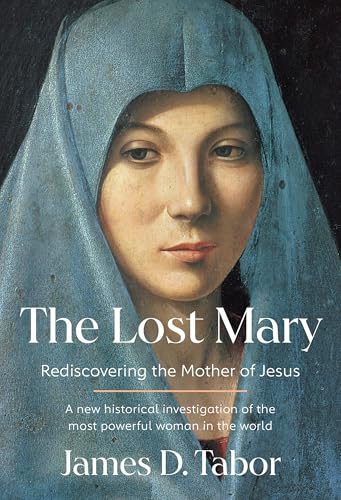
Book Review: The Lost Mary, Rediscovering the Mother of Jesus

When I happened upon a blurb about this recently-published book, I checked to see if my local library has it. I was pleased to find out they had a copy and I checked it out. In amongst my other reading, I found time to read the first few chapters of the library copy before it came due; I couldn’t renew it as other patrons have holds on the book. I’ve found The Lost Mary – Rediscovering the Mother of Jesus to be thought-provoking enough to want my own copy.

Fortunately, the timing of this book’s recent publication dovetails nicely with my master’s in theology studies. We had learned in class that much of what we know about Mary comes from “The Gospel of James (or the Protoevangelium of James).” ….. It’s widely known that there are four “canonical gospels” – the gospels of Matthew, Mark, Luke, and John that are in the Bible. In addition to the four canonical gospels, there are other gospels – some of which are “heretical” and others that are not heretical….. I learned in my studies that the “non-heretical, non-canonical” gospels are read by the church and religious scholars to provide “supplementary history” that enrich what we know from the four canonical gospels. Rabbit hole – this lead to me ordering Robert J. Miller’s book The Complete Gospels and I read “The Gospel of James (or the Protoevangelium of James).” In the Protoevangelium of James, I discovered that Mary’s parents (Joachim and Anna) were wealthy and that Joseph functioned as more of a guardian than a spouse to Mary. I was curious to learn more.

Then, I came upon James D. Tabor’s book The Lost Mary – Rediscovering the Mother of Jesus.

What I find intriguing about this book is that the author – James D. Tabor – goes beyond what we commonly know today about Mary life to consider the historical context of her life. What was it like historically for Mary to be living in Judea at the time that she lived? Tabor looks into topics – and ponders to the sociological impact on Mary’s life of what was happening at the time – the daily details of Roman conquest, a description of the town where her parents were likely living when she was born, Joseph needing to look for a Hebrew midwife when Mary went into labor, the idea that Jesus likely visited his wealthy maternal grandparents when he was a child, etc. It’s never occurred to me to ponder Jesus’ childhood visits with extended relatives and other day-to-day aspects of Jesus and Mary’s lives. Therefore, I am finding it insightful to consider the ideas presented in this book. Does writer and historian James D. Tabor accurately figure out every possible aspect of Mary’s life? Who knows. Even if Tabor goes down some tangents that may be open for debate, Tabor is raising points that broaden and enrich the reader’s understanding of the teenager who gave birth to Jesus.

I am looking forward to having my own copy of this book that I can keep on my bookshelf as a reminder that we should want to know more about the life of Mary.

Bibliophile and would-be-antiquarian Kim Burkhardt reviews books at The Books of the Ages and at The Hermitage Within. If you are a new visitor, it would be great to have you follow this blog (thank you!). If you know someone who would like this blog, please share it with them (thank you!).

Plug for “1,000 Libraries”

In this book blog (The Books of the Ages), I normally review books.

In this post, I am plugging the website “1,000 Libraries.”

Books live in libraries, bookstores, book cafes, and on shelves in our homes. When I was looking for my current that residence I moved into last year, I told the realtor that “I need a place with enough wall space for my books.” Books are important.

Books feed our souls. Because books feed our souls, the libraries, book shops, and book cafes where books live should also “feed our souls.” Therefore, I was thrilled a couple of months ago when I discovered “1,000 Libraries.” “1,000 Libraries” encourages public awareness about and appreciation of – through its’ website, a book it publishes, and an annual “most beautiful library” contest – the world’s great libraries.

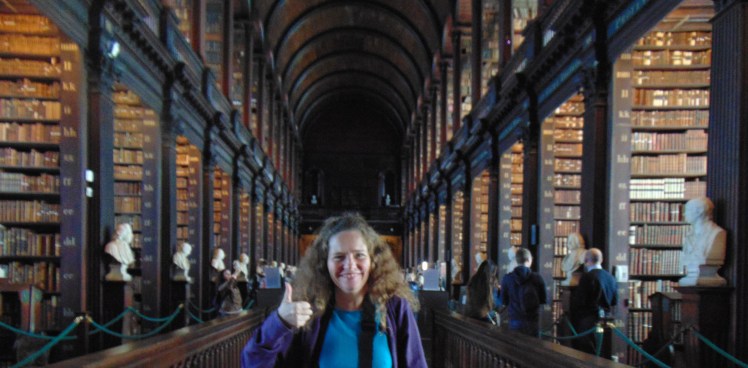
I was happy to discover that the 2025 “most beautiful library” selected by “1,000 Libraries” is a library I’m shown standing in on the About the Proprietor page of this website (I had long hair then) – the old library at Trinity College Dublin. Three of my ancestors did their medical degrees at Trinity College Dublin in the 1800’s, so I felt tingles up and down my spine when I walked the halls of Trinity’s old library when I visited Ireland in 2018….. When I walked the halls of Trinity’s library, I wondered how many times my ancestors visited this same library. I wondered if any of the books they read are still in the library (probably!)….. Also profiled on the “1,000 Libraries” site is an architecturally engaging library I visited in New York City in 2010 during a business trip (I was in a particularly sappy mood at the time and the library provided me with much-needed solace).

The fact that you found your way to this “The Books of the Ages” book reviews site probably means that you are a book lover (a lovely kind of person!). If you are indeed a book lover, I encourage you to visit the “1,000 Libraries” website. Lovely places that house books are – indeed – nourishment for book lovers’ souls. FYI, the “1,000 Libraries” website has a book profiling libraries – you might just decide to buy a copy! Further, the “1,000 Libraries” website just might encourage you to plan a trip to a far away land to visit one of the wonderful libraries they profile – a lovely idea!

Bibliophile and would-be-antiquarian Kim Burkhardt reviews books at The Books of the Ages and at The Hermitage Within. If you are a new visitor, it would be great to have you follow this blog (thank you!). If you know someone who would like this blog, please share it with them (thank you!).

Book Review: Freedom – Angela Merkel’s autobiography

Angela Merkel's autobiography
Angela Merkel’s autobiography

I am half way through this autobiography of Germany’s Chancellor 2005 – 2021.

I am finding this book to be an important and engaging read for several reasons. For starters, it’s always worth reading about world leaders to understand the world’s political stage and current events. This book does not disappoint – it provides a high level of insight about the context and dynamics of Angela Markel’s German government. Insights into how governments function, how decisions are made, and the “behind closed door” interactions between world leaders make Merkel’s memoir a very readable and useful book.

Further, I am benefitting from Merkel’s own descriptions of how she developed professionally. “Finding out where our limits are,” finding the confidence to step into new roles, etc. – such insights have applicability for all of us.

This book is going to live on my bookshelf next to the biographies and personal memoirs of Madeleine Albright, Barack Obama, Abraham Lincoln, Winfield Scott, etc.

Bibliophile and would-be-antiquarian Kim Burkhardt reviews books at The Books of the Ages and at The Hermitage Within. If you are a new visitor, it would be great to have you follow this blog (thank you!). If you know someone who would like this blog, please share it with them (thank you!).

Book Review: The Shadow of the Wind

Book: The Shadow of the Wind
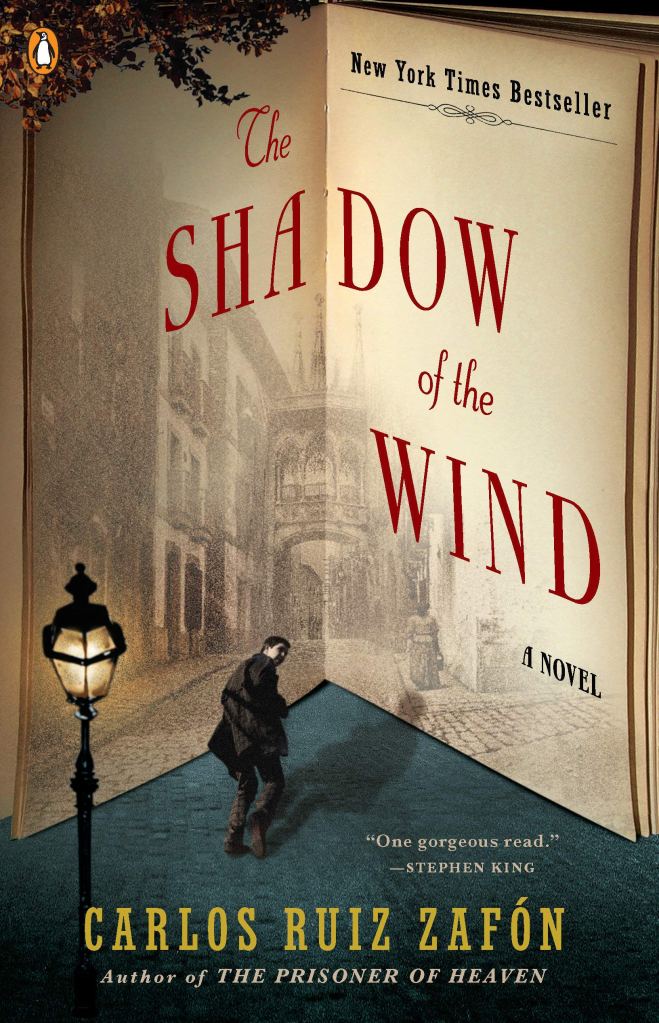
The Shadow of the Wind

I came upon Carlos Ruiz Zafon’s The Shadow of the Wind during COVID. I was out walking one day (alone, of course, there was a pandemic on….) and stopped at a Little Free Library in North Seattle. I went home with a whirlwind of a psychological thriller that captivated my imagination for weeks.

The Shadow of the Wind is set in Barcelona in 1945. This novel is wonderfully about books. And about people. And Barcelona. And, psychological suspense.

In this book, the writer manages to keep much in “the shadows” throughout the book – no way to “catch the whodunnit.” We are taken on the wind through the suspense of plot. Bottom line, Carlos Ruiz Zafon knows how to write.

This novel is dark. I attest to the author’s ability to write – the novel’s darkness took me into the depths of a dark despair. However, I couldn’t put the book down. When I had started reading a different book (several years earlier) that also led me into the depths of despair, I donated that other book to the library to get it out of my house rather than continue reading it. This book, however, doesn’t provide that option. I was so emotionally drawn into the book that I had to continue reading it. When I got to the end of the book, I was glad to have read it.

I’m looking forward to when I’ve forgotten enough details of the book that I can read it again. When I read it again, I’m going to be prepared for the depths to which the book takes the reader. The Shadow of the Wind is a must-read.

Bibliophile and would-be-antiquarian Kim Burkhardt reviews books at The Books of the Ages and at The Hermitage Within. If you are a new visitor, it would be great to have you follow this blog (thank you!). If you know someone who would like this blog, please share it with them (thank you!).

Book Review: The Ecumenical Councils of the Catholic Church (A history)

Book: The Ecumenical Councils of the Catholic Church
Book review: The Ecumenical Councils

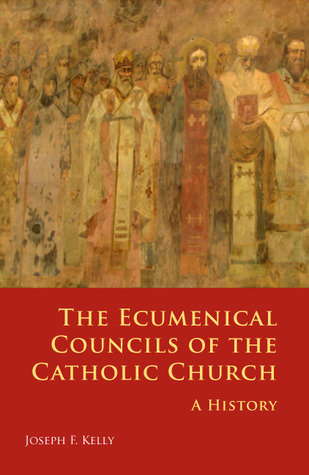
This book – The Ecumenical Councils of the Catholic Church: A History (author: Joseph E. Kelly) – is anything but a dry read.  

More than just a book for religious historians, this book provides wide details and context on how church leaders came together – and sometimes didn’t come together – over the centuries to debate and articulate Christian theology.

I count myself among the bibliophiles who believe that every word of a book should be read to consider the book as having been read.   In the case of this book, there is so much historical detail about each council, and historical context surrounding each council, and absorbing trivia that I am finding myself selectively choosing how much to summarily read about each time period the first time through this book (I may satisfy myself with selectively reading the book once through and keeping it a reference book).   “Really?,” I found myself pondering.  “A, B, X, Y really happened at this or that council or during this or that period in Church history?!?!?”  As I read, I am scribbling trivia on sticky-notes to tell friends and fellow church folk about what I am learning about the history of the Christianity’s twenty-one ecumenical councils.  As many of us know, the first council was the Council of Nicea in 325 through to Vatican II in the 1960’s. 

Just this afternoon, I learned that an Empress was involved in the second council of Nicea in 786/7.   Some councils were more ecumenical than others – in some cases, the councils were more heavily attended by bishops from the east than bishops from the west; today, individual denominations decide for themselves which of these historical councils were “ecumenical” (of note, the book’s author provides a listing within the book of which denominations consider with councils to have been ecumenical).

For non-historians, reading this book seriously will take the reader into reading additional books to learn more about the history and context of what was happening at the time of each council. 

There’s plenty in this book for both historians and fans of religious trivia.   It’s a book that really needs to be read over time so as to really absorb the content covered for each time period.

Bibliophile and would-be-antiquarian Kim Burkhardt reviews books at The Books of the Ages and at The Hermitage Within. If you are a new visitor, it would be great to have you follow this blog (thank you!). If you know someone who would like this blog, please share it with them (thank you!).

Book Review: Spiritual Direction in the Early Christian East

Book
Authors: Irenee Halisherr, Foreward Bishop Kalistsos Ware

I very much enjoyed finding this book, Spiritual Direction in the Early Christian East. I was equally thrilled to discover that it was published by Cistercian Publications (I worked for a Cistercian monk-priest for a time……).

This is among books written on very specific topics – it’s great to find such books when they are written on a topic of personal interest. I take an interest in the history of religious thought in the Medieval period and earlier. I am also currently exploring spiritual direction. Thus, I was excited to order this book and read it.

A number of passages in the foreward prove tangible to the reader interested in spiritual direction:

  • The ministry of the spiritual father is already foreshadowed in the New Testament; ‘Though you have countless guides in Christ, you do not have many fathers. For I became your father in Christ Jesus through the Gospel.’ (1 Cor 4:15)”
  • “He helps his children in Christ precisely because he is willing to share himself with them, identifying his own life with theirs.”

Within the book itself, any number of passages artfully describe spiritual direction:

  • Desert fathers have, if not brought into being….at least, systemized this magnificent thing….’the divine art of healing another.'”
  • We should examine ….[the qualities]…. the Byzantines deemed most necessary to the exercise of spiritual direction.” This section of the book starts with discussion of any would-be spiritual director needing to possess the quality of charity with the aspect of charity that involves being loving (spoiler alert: read the book to discover the other deemed-necessary qualities!).
  • Later chapters of the book discuss how to enter into spiritual direction as a directee in such a way as to benefit from receiving spiritual direction – a useful topic of instruction.

In addition, any number of passages interestingly discuss Eastern Christianity:

  • This book is addressed to Western Christians interested in the East: the main intention is to make them breathe the spirit of which animated the great spiritual masters of the past….”
  • “Almost all the documents [referenced in the main of the book] belong to monastic literature. It could not be otherwise. Spiritual direction was not taught and practiced to perfection except among monks.”
  • “….abba Elias and abba Dorotheos….devoted themselves to a large monastery of virgins in Antripe, upper Egypt…..Their role, which they assumed spontaneously out of compassion consisted in maintaining or re-establishing peace among the some three hundred ascetrie (women ascetics) who had been accepted there…..” [Note: I now find myself wondering what literature is available for learning more about ascetrie!]

Spiritual Direction in the Early Christian East is an important contribution to books on spiritual direction and literature about Eastern Christianity – particularly the practice of spiritual direction. I encourage anyone interested in one or both topics to pick up this book.

Bibliophile and would-be-antiquarian Kim Burkhardt reviews books at The Books of the Ages. If you are a new visitor, it would be great to have you follow this blog (thank you!). If you know someone who would like this blog, please share it with them (thank you!).

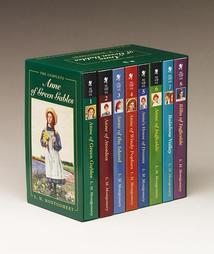
Book Review: Anne of Green Gables

Set of books
Series: Anne of Green Gables

I first became aware of the “timeless classic” series of Anne of Green Gables books when I was in my early teens. My step mother talked about liking the books – I wanted to like the books because she did.

The “spirited redhead orphan” in Prince Edward Island is wonderfully portrayed in these books. We get to watch her grow up and journey through adulthood, complete with her ongoing series of childhood antics.

I did read a couple of the books in this eight-book series when I was a teenager, then moved on to other things. I have recently come back to Anne of Green Gables. In looking for a distraction from the other topics I’ve been reading recently, Anne is proving to be a pleasant distraction. Her character is portrayed in a readable way. Further, the author wrote these books in a light, easy-reading style yet also inserts insightful observations that engross our interest in human nature.

This time, I am re-reading the first two books so that I can read the remaining six books. I find myself dog-earing pages that have interesting observations worth reflecting up repeatedly.

Bibliophile and would-be-antiquarian Kim Burkhardt reviews books at The Books of the Ages. If you are a new visitor, it would be great to have you follow this blog (thank you!). If you know someone who would like this blog, please share it with them (thank you!).

Book Review: Grief on the Road to Emmaus

I recently bought Beth L. Hewitt’s Grief on the Road to Emmaus.

I read a lot of books; I am finding this one to be a book that is both readable and experiential. Given that I spent years keeping my mind and emotions separate, I now appreciate a book that engages both mind and heart in a life-engaging, reflective manner.

Beth Hewitt observes in this book that not only do we need to grieve the loss of our loved ones who pass on (or move out of our lives, I suppose), we have to grief life’s pathways that don’t go the way we would have preferred. Lost a job? Grieve. Lost a limb? Grieve. Got robbed? Grieve. Got seriously injured in an accident? Grieve. I’ve probably heard this before, but it didn’t sink in. “Just move on” is the motto many of us expect shall get us through life’s challenges. Wrong. We need to grieve. When we don’t grieve, we don’t heal. When we don’t heal, we don’t really move on.

Further, Hewitt’s instructions on how to be present with people who are grieving has application in daily life. If we were to start treating everyone with the approaches described in this book – such as # – life would be less transactional, more interactional.

Something I didn’t know when I ordered this book is that Beth Hewitt wrote this book from a Benedictine view. Wow, added bonus. I am a parishioner at a St. Benedict parish and, as such, have learned some Benedictine lessons from this parish in recent years; this book is complimenting those lessons in helpful and meaningful ways. Loving the book!

Book reviewer Kim Burkhardt blogs at The Books of the Ages and at our partner organization, A Parish Catechist.