The ways through which we travel our faith journey – church attendance, types of prayer, etc. – should nurture our faith journey. If anything we participate in feels as though it is constricting our faith journey, either something is amiss or we are ready for additional or different faith activities. Being attentive to any sense of constriction is an opportunity to look to adapt either ourselves or our situation. It is entirely good when we notice that we need to adjust – we are being attentive in our faith journey (or, sometimes, it is an indication that we simply need to become more engaged). With a new year starting (2026) and with the Christmas season ending soon, this is a good calendar time to consider adding something new as we approach Ordinary Time (starting January 12).
By way of example, I am starting a Master’s in Theology in January (a “Masters in Theology Studies” or “MTS” for lay people rather than a Master’s in Divinity for pastors-in-training). At a recent meeting for registered MTS students, we were provided with the first of our faith formation sessions. We were told that Masters in Theological Studies degrees typically cover four academic subjects – scripture, ethics, systemic theology, and historical theology. In addition to academics, MTS programs – ours, at least – include faith formation of enrolled students – the degree process should include our faith maturation in addition to a focus on academics (a whole person approach). We were instructed to start participating daily in Liturgy of the Hours (Divine Office) – the daily prescribed prayer life of the Church.
In recent years, my prayer life has principally been one of contemplative prayer – both at home and in small prayer groups via Contemplative Outreach. There are as many ways to pray as there are people; contemplative prayer has been personally fruitful for me. In contemplative prayer, I encounter periods of time in which I experience God loving me – which has been freeing me from difficult aspects of “the human condition.” As with anything else, I do also experience occasional dry periods in my experience with contemplative prayer. Therefore, I am now open to also praying Liturgy of the Hours (Diving Office).
Prior to being recently instructed to start participating in Liturgy of the Hours, I viewed the Divine Office remotely (“from afar”) as the prerogative of priests and avowed religious – a respected activity distant from my daily life. When we were recently told to start participating in Liturgy of the Hours, part of me was intrigued. Another part of me was also relieved when we were told that Liturgy of the Hours is “a tool to help us pray, not a straight jacket to keep us from praying.” I am enjoying the journey into the Divine Office.
This daily prescribed prayer life of the Church is the Catholic church’s formal prescribed method for priests, deacons, avowed religious (i..e, nuns, brothers, etc.), and interested lay people to participate in Paul’s instruction for us to “pray without ceasing” (I think several other liturgical denominations also have Liturgy of the Hours?).
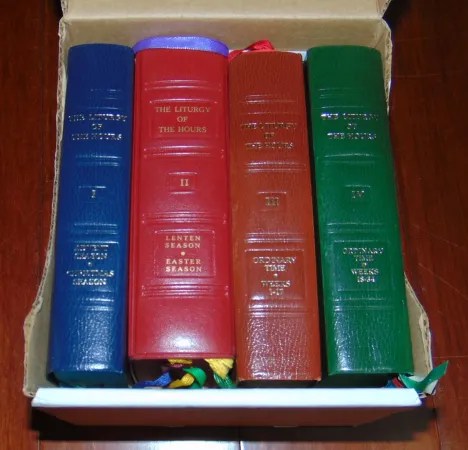
The print version of Liturgy of the Hours – around since 1970 as an outgrowth of Vatican II – is a series of four books with morning, evening, and throughout-the-day prayers for each liturgical season, feast days and Solemnities, and each day of the year. When I brought home a complete set of Liturgy of the Hours, I felt good about undertaking this new project. I was also surprised: finding one’s way to each days’ readings depends upon navigating pages and sections depending upon the liturgical season and assigned readings for specific feast days, holy days, etc. – it’s like navigating a small library’s equivalent of the Dewey Decimal System. No matter – praying the Hours means sharing in the mutual prayer life of everyone worldwide who prays the Liturgy of the Hours. For people who want to “keep it simple,” there are apps that will bring you each day’s readings. For lay people, we have the option of praying only the morning prayers (upon rising) and evening prayers (before going to bed).
A new, updated version of Liturgy of the Hours (Divine Office) – the daily prescribed prayer life of the Church – is the Catholic church’s formal prescribed method for priests, deacons, avowed religious (i..e, nuns, brothers, etc.), and interested lay people (I think several other liturgical denominations also have Liturgy of the Hours?).
The current print version of the Catholic Liturgy of the Hours – around since 1970 as an outgrowth of Vatican II – is a series of four books with morning, evening, and throughout-the-day prayers for each liturgical season, feast days and Solemnities, and each day of the year. When I brought home a complete set of Liturgy of the Hours, I felt good about undertaking this worldwide way of pray-without-ceasing. I was also surprised: finding one’s way to each days’ readings depends upon navigating pages and sections depending upon the liturgical season and assigned readings for specific feast days, holy days, etc. – it’s like navigating a small library’s to find each day’s readings. No matter – praying the Hours means sharing in the mutual prayer life of everyone worldwide who prays the Liturgy of the Hours. For people who want to “keep it simple,” there are apps that will bring you each day’s readings. For lay people, we have the option of praying only the morning prayers (upon rising) and evening prayers (before going to bed).
For anyone aware that avowed religious in monasteries get up at times like midnight and 3:00 or 4:00 am to do Liturgy of the Hours, I recently came upon interesting trivia regarding this practice. While most of us groan at interrupting a good night’s sleep, there’s actually a historical precedent explaining that this night time practice isn’t as difficult as it would seem. Prior to the Industrial Revolution – when night time lighting became available – it was biologically customary for people to sleep in two phases. In this biphasic sleep pattern, people had what Europeans called “first sleep” and “second sleep” – meaning that people would sleep for awhile (“first sleep”), then naturally wake up for an hour or longer and undertake activities before returning to sleep for “second sleep.” An interesting BBC article (available here) discusses this historical biphasic sleep pattern. Therefore, the monastic habit of a during-the-night portion of Liturgy of the Hours blends naturally with humanity’s historically-normal sleep patterns.
A new, updated Catholic version of Liturgy of the Hours is coming out in 2027.
Bibliophile and would-be-antiquarian Kim Burkhardt reviews books at The Books of the Ages and at The Hermitage Within. If you are a new visitor, it would be great to have you follow this blog (thank you!). If you know someone who would like this blog, please share it with them (thank you!).
 The Books of the Ages