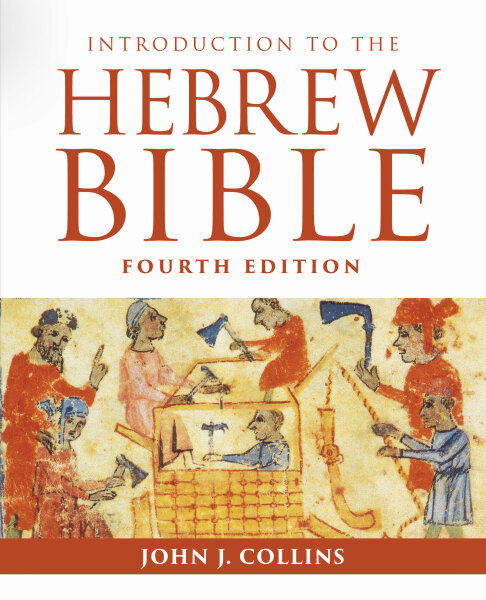
I am reading John J. Collins’ book Introduction to the Hebrew Bible (Fortress Press) for a graduate course on the Hebrew Bible (Old Testament).
This is book for highly educational. The book itself is informative – I am learning a great deal about the historical, social, religious, and geographic contexts of the Near East.
The book’s contents are dense enough that I am regularly taking time to pause for reflection. I am now able to discuss the North and South kingdoms of Israel and Judah, for example, while being able to explain how Judaism and Christianity each came to call the first five books of the Hebrew Bible the Torah and the Pentateuch respectively. I looked up and printed out several maps to become more familiar with the geographic region of the Bible.
I was already aware – before reading this book – that recent Biblical scholarship thinks of several groups of writers for sections of the Hebrew Bible – the “E,” “D,” “J,” and “P” (priestly) sources. It’s interesting to read again about the academic theories about these various groups of writers.
This book is a great resource for anyone who wants to better understand the Hebrew Bible. In my case, I have previously read the Hebrew Bible and New Testaments – from the first page of Genesis to the final page of Revelations. I also took an undergraduate course from a rabbi on “The History and Culture of Ancient Israel.” Reading the entire Old and New Testaments and taking an undergraduate course before starting this book were both helpful in being able to take in the content of the Introduction to the Hebrew Bible.
The author taught at Yale Divinity School.
Bibliophile and would-be-antiquarian Kim Burkhardt reviews books at The Books of the Ages and at The Hermitage Within. If you are a new visitor, it would be great to have you follow this blog (thank you!). If you know someone who would like this blog, please share it with them (thank you!).
 The Books of the Ages