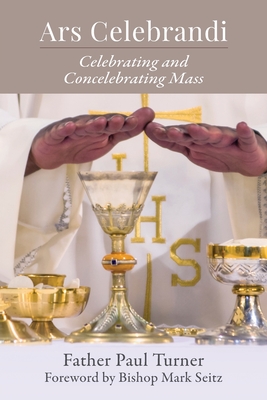
This book, written for priests to inspire artful presiding at mass, brings to life the nuts and bolts of how the Catholic mass brings liturgy – the work of the people – is celebrated. For the non-ordained among us, Ars Celebrandi: Celebrating and Concelebrating Mass provides insight into how the liturgy is designed to invigorate the faith of the faithful.
In practical terms, this book picks up where the General Instruction of the Roman Missal (the “GIRM”) ends….. The GIRM is the instruction manual of “how to do a Catholic mass,” whereas Ars Celebrandi gets into the art of how to preside.
Two examples of this book’s insights come from the foreward of Ars Celebrandi (written by Bishop Mark Seitz):
“The liturgy is the action of the entire people of God who are being more perfectly formed into the Body of Christ. The Second Vatican Council’s seminal teaching that the people of God are called to full, conscious, and active participation is based upon this fundamental recognition.”
“The liturgy, as we know, is a language and a certain style of communication that comes down to us from the ages but is also constantly adapting under the guidance of the Spirit in every age. It a language of signs and symbols that are read universally by people in the church. To be sure, there are regional and cultural aspects that are rightly represented as local communities worship, but these are secondary to the expressions that unite us across times and places.”
Then, we lay readers learn in this book about the complexity of presiding at church services. For example:
“[Presiding at a liturgy] involve a marriage of books and ministers. The liturgical norms [i.e., what is suppose to be done] encounter a real-time relationship with the individual persons ordained to carry them out….The relationship presumes that priests know the liturgical norms. However, the rules are complex. The books detailing them are many. Some laws keep changing….Furthermore, not every aspect of liturgy is prescribed. When presiding, a typical priest is suppose to do certain things, is free to do certain other things, and takes freedom to do even more….” [Subsequent paragraphs delve into specific examples of these “certain things” and “certain other things.}
Reading this book is of interest for we lay people in that we become more observant of the nuts and bolts of what happens at church. A book worth reading.
Bibliophile and would-be-antiquarian Kim Burkhardt reviews books at The Books of the Ages. If you are a new visitor, it would be great to have you follow this blog (thank you!). If you know someone who would like this blog, please share it with them (thank you!).
 The Books of the Ages