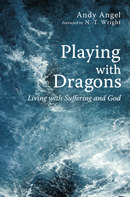
I heard of this book recently while watching one of “The Great Courses” about the history of the Old Testament. The Great Courses presenter who mentioned this book was discussing the cultural context of how dragons came to be mentioned in the Hebrew Bible; in the context of that presentation, he referred to this book Playing with Dragons in the same sense of the book’s Goodreads summary, saying (in effect): “This is a book for those want to go beyond standard discussions of faith and suffering.”
There are multiple layers of opportunity for understanding the depths of religious meaning. The academic/sociologist/theologian James Fowler chronicles in his book Stages of Faith the six stages we have the opportunities to progress through in faith as we age; too often, we adults settle for remaining perpetually in a high-school level of a stage three faith (as described by Fowler). In hindsight, I got stuck for some years as an adult in a transition moving from a stage three faith to stage four faith (a common occurrence, according to Fowler). It took time for me to begin growing in faith again; once I did, I was happy to discover new depths of religious insight – such as metaphors provided to us in Biblical texts and religious ritual. Therefore, I looked forward to Andy Angel’s book Playing with Dragons, Living with Suffering and God when I found recently found the book. I, as the Goodreads summary for this book mentions, “find standard discussions of faith and suffering frustrating” – I often find such discussions inadequate.
Personally, I accept that suffering is “part of the human condition” and a consequence of original sin. God gave us humans the opportunity to have a naturally happy time of it on earth; that opportunity was destroyed through free will via “original sin.” I don’t find the concept of original sin to be a limiting and heavy weight put on humanity; rather, we are provided with the opportunity to move beyond it through baptism and by nurturing a right relationship with God and the people around us.
In this Playing with Dragons book, I am hoped for discussion about how dragons are provided as a metaphor for us to wrestle on a human level with the challenges we must contend with during this lifetime.
This book is summarized on Goodreads as follows: “There be dragons all over the Bible. From the great sea monsters of Genesis to the great dragon of Revelation, dragons appear as the Bible opens and closes, and they pop their grisly heads up at various junctures in between. How did they get there and what on earth (or indeed in heaven) are they doing there? This is a book for those who find standard discussions of faith and suffering frustrating. Andy Angel opens up the rich biblical tradition of living with God in the midst of suffering. He takes the reader on a journey of exploration through biblical texts that are often overlooked on account of their strangeness–texts about dragons. He shows how these peculiar passages open up a language of prayer through suffering in which people share their anger, weariness, disillusionment, and even joy in suffering with God. Angel explores how such “weird” Scriptures open up a whole new way of praying and reveal a God who approves of honest spirituality, a spirituality that the Bible holds open but too many of its interpreters do not.”
What I found in the book was a cultural and religious context of the Old Testament – how and why dragons were symbolic representations of the challenges we wrestle with and – importantly – that metaphor provides us with a way to “wrestle with life’s challenges” in ways that literal vocabulary fails us. Epic dramas are useful.
Kim Burkhardt blogs at The Books of the Ages and A Parish Catechist. If you are a new visitor, it would be great to have you follow this blog (thank you!). If you know someone who would like this blog post, please share it with them (thank you!).
 The Books of the Ages