Book Review: “Light from Light” (Nicene Creed)
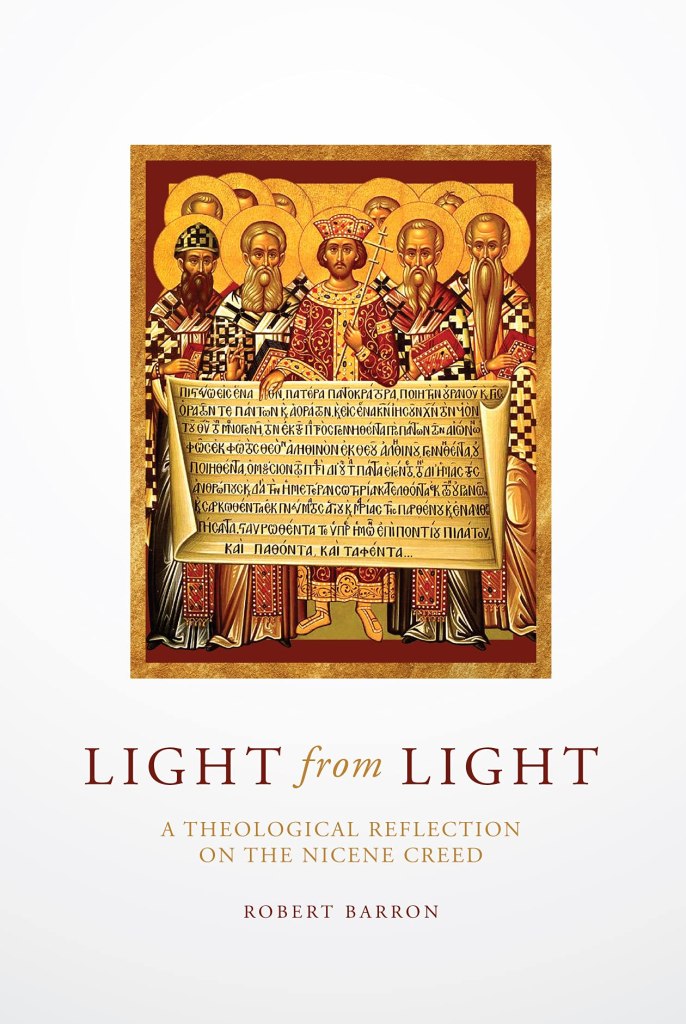
I have blogged elsewhere about two books I have previously read about the Christian – Catholic – creeds (check out that previous blog post here).

Now, my Master’s in Theology program has us reading Bishop Robert Barron’s Light from Light book that does a deep into the Nicene Creed.

For anyone not familiar with the Nicene Creed, it was formulated by a body of bishops in the year 325 at the Council of Nicea in what is now Turkey (“I believe in one God, the Father almighty….light from light, true God from true God…..”).

While I have already read other books on the Nicene Creed and the Apostle’s Creed (the two creeds are quite similar in content), I still find it insight to periodically read another book on the subject when the book is well written. Knowledgeable and capable writers can each bring their own collection of insights to the topic – offering useful reading at varying stages in our lives.

I am currently mid-way through chapter one of Robert Barron’s Light from Light. I have already found items to highlight – points that I find insightful at my current stage in life. For example, Robert Barron states on page 22 “authentic faith or belief has not a thing to do with naive credulity or accepting claims on the basis of no evidence. Faith, in a word, is never below reason, never infra-rational. The Church has absolutely no interest in encouraging superstition or intellectual irresponsibility.”….”Newman insisted on the intellectual integrity of faith.”

I encourage anyone who wants to practically understand Christianity’s core beliefs to read any of these books on Christianity’s creeds. It’s easy enough to think we are familiar with Christianity (in varying degrees, most people have some-to-more-than-some knowledge about Christianity). Barron’s Light from Light and the other “deep dive into the creed” books I reviewed (above) get into the nitty-gritty in ways that increase one’s understanding in useful ways.

Bibliophile and would-be-antiquarian Kim Burkhardt reviews books at The Books of the Ages and at The Hermitage Within. If you are a new visitor, it would be great to have you follow this blog (thank you!). If you know someone who would like this blog, please share it with them (thank you!). FYI, you can $$ support this blog by clicking here here to do your Amazon shopping (if you click here before you start your Amazon shopping, Amazon pays us a commission when you shop via the link provided – thank you).
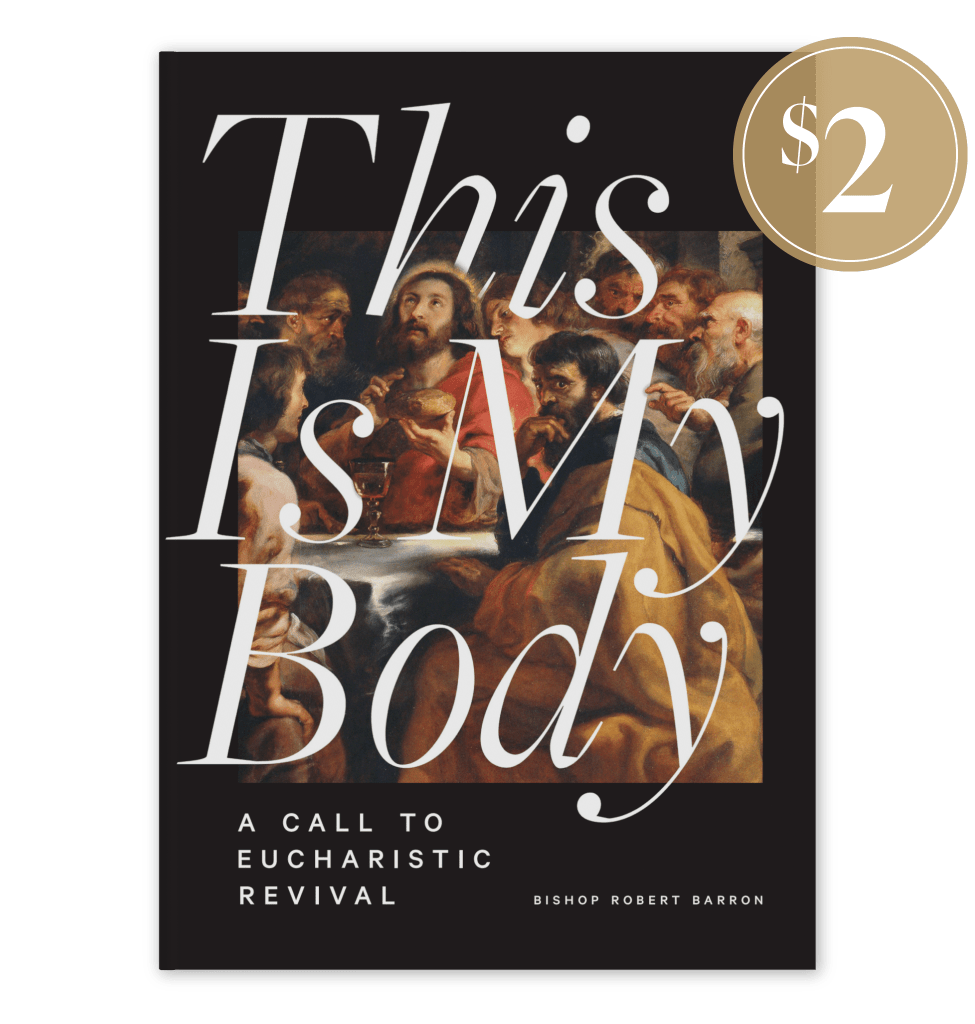
Book Review: This is My Body, A Call to Eucharistic Revival

Book: This is My Body, a Call to Eucharistic Revival

was recently given Bishop Robert Barron’s book This is My Body: A Call to Eucharistic Revival. When I started reading it, I quickly found it as readable and engaging as Henri Nouwen’s book With Burning Hearts.

The author, Bishop Robert Barron, wrote this book as part of a U.S. “call to Eucharistic renewal” (he helped initiate a U.S. call to Eucharistic renewal while the Chair of the Committee on Evangelization and Catechesis for the United States Conference of Catholic Bishops, USCCB). This book is engaging because it takes readers to the deeper meaning of faith concepts we’re meant to learn; he does so in an easily readable and interesting manner – plenty of “ah ha” moments. At the risk of reviewing this book with too much hyperbole, I stopped earmarking interesting pages after a few pages because I was earmarking most pages.

Here are two excerpts from This is My Body, A Call to Eucharistic Revival:

….”The opening line of the book of Genesis tells us that ‘in the beginning, God created the heavens and the eart’ (Gen. 1:1). Why did God, who is perfect in every way and who stands in need of nothing outside himself, bother to create at all? There are mythologies and philosophies galore – both ancient and modern – that speak of God needing the universe or benefiting from it in some fashion, but Catholic theology has always repudiated these approaches and affirmed God’s total self-sufficiency….God created the heaven and earth ‘of his own goodness and almighty power, not for the increase of his own happiness.'”

“Love, in the theological sense, is not a feeling or a sentiment, though it is often accompanied by those psychological states. In its essence, love is an act of the will, more precisely, the willing of the good of the other as other. To love is really to want what is good for someone else and then to act on that desire.”

This book is intentionally priced affordably to get it into the hands of readers. I am passing along copies to fellow readers who live in my community. If you are looking for something to read, you can order it online here.

Kim Burkhardt blogs at The Books of the Ages and A Parish Catechist (and a “Content Creator/Individual” member of the Association of Catholic Publishers). If you are a new visitor, it would be great to have you follow this blog (thank you!). If you know someone who would like this blog post, please share it with them (thank you!).