Faith Reading challenge: The Brothers Karamazov
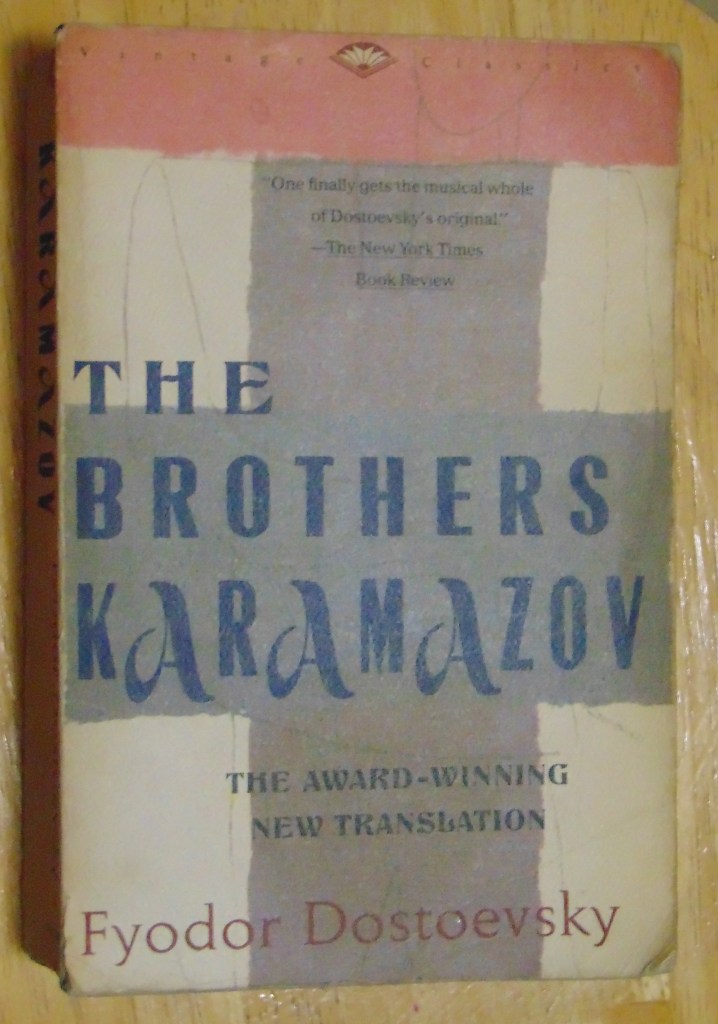
The Brothers Karamazov

I took a literature class in college in which we read Dostoevsky’s The Brothers Karamazov.

I attended a state university and we read The Brothers Karamazov as secular literature. While we read the book as secular literature, I do remember our instructor posing a question about a particular point for one of the books’ characters. I found myself responding as seeing the character as analagous to a friend of mine who was serving as a spiritual guide for me at the time. My instructor and classmates found this odd and laughed as such. It was an awkward moment.

Since then, I have periodically heard reference to “The Brothers K” as being a book – in part – about faith. Goodreads (an online book portal) says of the book, “Through the gripping events of their story, Dostoevsky portrays the whole of Russian life, is social and spiritual striving, in what was both the golden age and a tragic turning point in Russian culture.”

Because I have repeatedly heard of the book as having spirituality dimensions, I am planning to read “The Brothers K” again, after I finish reading another book (a long book that I’m reading rather slowly). This time, I will read “The Brothers K” through the lens of spirituality. I invite each of you to join me in reading the book to consider its’ faith dimensions; we can then discuss the faith ideas in book.

Put May 1 on your calendar as the date to start reading The Brothers Karamazov through the lens of faith. I will post dates to begin discussing the book.

Kim Burkhardt blogs at The Books of the Ages and A Parish Catechist (and a “Content Creator/Individual” member of the Association of Catholic Publishers). If you are a new visitor, it would be great to have you follow this blog (thank you!). If you know someone who would like this blog post, please share it with them (thank you!).
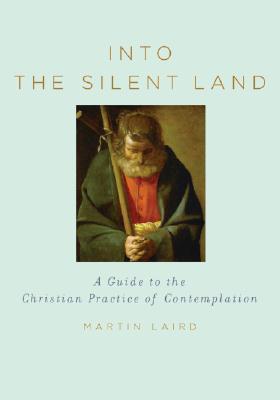
Book Review: Martin Laird’s ‘Into the Silent Land’

Book: Into the Silent Land

I was recently given a copy of Martin Laird’s Into the Silent Land: Christian Practice of Contemplation.

As a contemplative pray-er, I find this book refreshing. Rather than only being a how-to book on the mechanics of how to pray contemplatively, this is the type of contemplative prayer book I look for: a description of what happens when we do a deep dive into contemplative prayer. It is – to paraphrase a speaker I heard once – the “poetry of our lives” that demonstrates the animation of one’s prayer life when prays contemplatively. Such poetry – it seems to me – helps lead readers into the experience of contemplative prayer via surrender into what we read in the books’ text.

A few “poetry of our prayer lives” excerpts:

  • “Silence is an urgent necessity for us: silence is necessary if we are to hear God speaking in eternal silence; our own silence is necessary if God is to hear us” (page 2).
  • “This book…proceeds from an ancient Christian view that the foundation of every land is silence (Ws 18:24), where God simply and perpetually gives himself” (page 6).
  • “…the grace of Christian wholeness that flowers in silence….dispels (the) illusion of separation [from God]” (page 16).

This is a short book, but it takes a long time to read – its’ contents are contemplated rather than merely read. It contributes meaningfully to one’s prayer life. This is a book I will keep.

Kim Burkhardt blogs at The Books of the Ages and A Parish Catechist (and a “Content Creator/Individual” member of the Association of Catholic Publishers). If you are a new visitor, it would be great to have you follow this blog (thank you!). If you know someone who would like this blog post, please share it with them (thank you!).
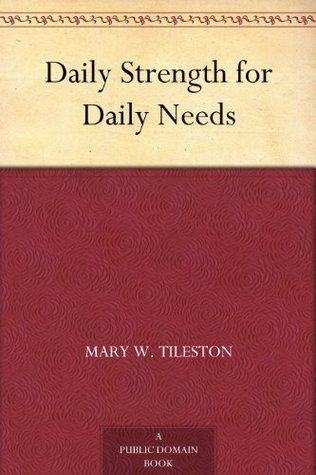
Book review: Daily Strengths for Daily Needs

Thank you to The Books of the Ages friend Karen Chartier for this book review. Much appreciated!

Book Review: Daily Strengths for Daily Needs

Mary W. Tileston

The Family Inspirational Library

Copyright 1928

Mary Tileston’s book Daily Strengths for Daily Needs offers a compilation of quotes from thoughtful, spiritual thinkers throughout the ages, from those found in the Bible to R.W. Emerson, to Marcus Antoninus, to George Elliot, to St. Frances de Sales — and scores of others.

Published first in 1884, it remains pertinent to the present. ‘In these days of great emotion and radical changes, we need the steady, persistent and refreshing inspiration of spiritual thoughts, which, entering the texture of our life in the morning, will guide and refresh us through the day, or, in the evening, give a sense of confidence and peace.’ opens the preface, and both the need and the outcomes outlined are relevant.

I was given this book by a friend and have been inspired by it throughout the year. I highly recommend it. Below are examples of quotes of Tileson’s book.

The one who will be found in trial capable of great acts of love, is ever the one who is always doing considerate small ones.          F. W. Robertson

A man is relieved and gay when he has put his heart into his work and done his best; but what he has said or done otherwise, shall give him no peace.                   R. W. Emerson

We may, if we choose, make the worst of one another.  Everyone has his weak points; everyone has his faults; we may make the worst of these; we may fix our attention constantly upon these.  But we may also make the best of one another.  We may forgive, even as we hope to be forgiven…By loving whatever is loveable in those around us, love will flow back from them to us, and life will become a pleasure instead of a pain; and earth will become like heaven; and we shall become not unworthy followers of Him whose name is Love.                      A. P. Stanley

Book Reviewer: Karen Chartier

Living in the Presence (Tilden Edwards): book review

I came upon Tilden Edwards’ Living in the Presence perhaps five or six years ago in a Little Free Library. It immediately became part of my lectio divina reading on contemplative prayer. Lectio divina refers to prayerful, reflective reading of scripture; I sometimes read non-scriptural books in much the same way.

I had been gifted a state of contemplative prayer starting in October, 2016. In the period that followed, I actively – in a reflective way – read a good number of books on contemplative prayer. Living in the Presence was among these books; it provided an ample amount of nourishment for my prayer journey.

This book also brought to my attention an organization founded by the book’s author, Shalem Institute for Spiritual Formation. While Living in the Presence gave me much nourishment as I read and re-read the book, finding that groups such as the Shalem Institute exist provided me with a good amount of hope.

A valuable read for individuals who want to nurture contemplative prayer.

Kim Burkhardt blogs at The Books of the Ages and A Parish Catechist .

Book Review: Grief on the Road to Emmaus

I recently bought Beth L. Hewitt’s Grief on the Road to Emmaus.

I read a lot of books; I am finding this one to be a book that is both readable and experiential. Given that I spent years keeping my mind and emotions separate, I now appreciate a book that engages both mind and heart in a life-engaging, reflective manner.

Beth Hewitt observes in this book that not only do we need to grieve the loss of our loved ones who pass on (or move out of our lives, I suppose), we have to grief life’s pathways that don’t go the way we would have preferred. Lost a job? Grieve. Lost a limb? Grieve. Got robbed? Grieve. Got seriously injured in an accident? Grieve. I’ve probably heard this before, but it didn’t sink in. “Just move on” is the motto many of us expect shall get us through life’s challenges. Wrong. We need to grieve. When we don’t grieve, we don’t heal. When we don’t heal, we don’t really move on.

Further, Hewitt’s instructions on how to be present with people who are grieving has application in daily life. If we were to start treating everyone with the approaches described in this book – such as # – life would be less transactional, more interactional.

Something I didn’t know when I ordered this book is that Beth Hewitt wrote this book from a Benedictine view. Wow, added bonus. I am a parishioner at a St. Benedict parish and, as such, have learned some Benedictine lessons from this parish in recent years; this book is complimenting those lessons in helpful and meaningful ways. Loving the book!

Book reviewer Kim Burkhardt blogs at The Books of the Ages and at our partner organization, A Parish Catechist.