Books live in libraries, bookstores, book cafes, and on shelves in our homes. When I was looking for my current that residence I moved into last year, I told the realtor that “I need a place with enough wall space for my books.” Books are important.
Books feed our souls. Because books feed our souls, the libraries, book shops, and book cafes where books live should also “feed our souls.” Therefore, I was thrilled a couple of months ago when I discovered “1,000 Libraries.” “1,000 Libraries” encourages public awareness about and appreciation of – through its’ website, a book it publishes, and an annual “most beautiful library” contest – the world’s great libraries.
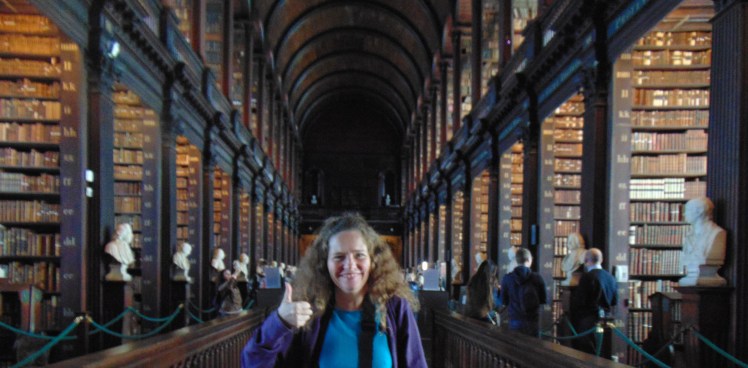
I was happy to discover that the 2025 “most beautiful library” selected by “1,000 Libraries” is a library I’m shown standing in on the About the Proprietor page of this website (I had long hair then) – the old library at Trinity College Dublin. Three of my ancestors did their medical degrees at Trinity College Dublin in the 1800’s, so I felt tingles up and down my spine when I walked the halls of Trinity’s old library when I visited Ireland in 2018….. When I walked the halls of Trinity’s library, I wondered how many times my ancestors visited this same library. I wondered if any of the books they read are still in the library (probably!)….. Also profiled on the “1,000 Libraries” site is an architecturally engaging library I visited in New York City in 2010 during a business trip (I was in a particularly sappy mood at the time and the library provided me with much-needed solace).
The fact that you found your way to this “The Books of the Ages” book reviews site probably means that you are a book lover (a lovely kind of person!). If you are indeed a book lover, I encourage you to visit the “1,000 Libraries” website. Lovely places that house books are – indeed – nourishment for book lovers’ souls. FYI, the “1,000 Libraries” website has a book profiling libraries – you might just decide to buy a copy! Further, the “1,000 Libraries” website just might encourage you to plan a trip to a far away land to visit one of the wonderful libraries they profile – a lovely idea!
Bibliophile and would-be-antiquarian Kim Burkhardt reviews books at The Books of the Ages and at The Hermitage Within. If you are a new visitor, it would be great to have you follow this blog (thank you!). If you know someone who would like this blog, please share it with them (thank you!).
I started reading Robert Reich’s blog a year or two ago based on the recommendation of a friend (more specifically, the blog arrives in my email in-box daily. Some days I open it up and read it…..).
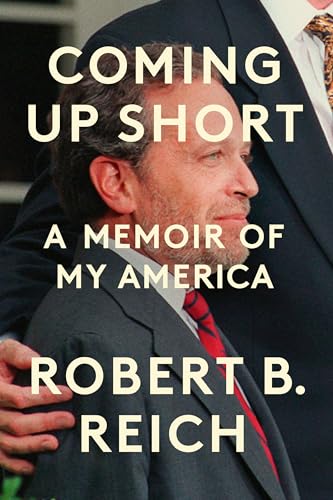
When I read Robert Reich, I always look forward to his self-deprecating “short jokes.” I am one inch taller than Robert Reich, so I understand the challenges of being a small adult (I don’t know if he has his clothes tailored or if he found a niche place to buy clothes, but my height – or lack thereof – is one of the reasons I own a sewing machine. I alter some of the clothes I buy retail. I also make some of my own clothes so that I get clothes that I like AND that fit…..) In the same vein as his choice of photos for this book’s cover, I carry around a photo of me standing next to a relative who is 6′ 11″. When Robert Reich’s latest book came out – Coming Up Short: A Memoir of My America – I decided, partly because of the play-on-words title, that I’m “up” for reading it.
When I got my copy of the book arrived, I had every expectation that this book is going to be worth reading. I started with the promotional quotes on the back cover; one of the blurbs started with, “Being bullied as a child helped Robert Reich become a champion for the little guy.” Books that are informative and provide us with personal value are doubly – more than doubly – valuable; it’s taken me until recently to see aspects of my life that “add value” to what I bring to the table….
Okay, enough about how and why I am personally drawn to this book.
Reading clear-eyed memoirs by national leaders have an opportunity to contribute to thoughtful citizenship. The last book I reviewed – Angela Merkel’s “Freedom” memoir – offered the insights of a political figure who I admire for both her politics and her gender. In the case of Robert Reich, he speaks of national matters with clarity.
In Coming Up Short, Reich writes on topics that resonate with everyday Americans. He does so by starting his book – in the first chapter – by talking about the bullies he encountered growing up. In getting broadly to topics affecting every day Americans, the blurb on the inside cover indicates that Reich will write how America can “reclaim a sense of community.” A friend mentioned to me a couple years ago that “The U.S. today isn’t the U.S. I remember growing up” – I got the sense from what he said that a loss of community was part of what he has seen disappear. More recently, I saw a guy walking down the street wearing a shirt that read “I miss the America that I grew up in” – ditto. I am looking forward to getting to the part of Coming Up Short that discusses rebuilding community.
Beginning with the early pages of Coming Up Short, Robert Reich alternates between two useful types of insight: generating hope in what American can be and writing in a way that resonates – with frank insight – about what’s going wrong in America and how those errors have come to be in recent decades. Now that I have started reading this book, I appreciate having it for my evening reading.
Bibliophile and would-be-antiquarian Kim Burkhardt reviews books at The Books of the Ages and at The Hermitage Within. If you are a new visitor, it would be great to have you follow this blog (thank you!). If you know someone who would like this blog, please share it with them (thank you!).
I am half way through this autobiography of Germany’s Chancellor 2005 – 2021.
I am finding this book to be an important and engaging read for several reasons. For starters, it’s always worth reading about world leaders to understand the world’s political stage and current events. This book does not disappoint – it provides a high level of insight about the context and dynamics of Angela Markel’s German government. Insights into how governments function, how decisions are made, and the “behind closed door” interactions between world leaders make Merkel’s memoir a very readable and useful book.
Further, I am benefitting from Merkel’s own descriptions of how she developed professionally. “Finding out where our limits are,” finding the confidence to step into new roles, etc. – such insights have applicability for all of us.
This book is going to live on my bookshelf next to the biographies and personal memoirs of Madeleine Albright, Barack Obama, Abraham Lincoln, Winfield Scott, etc.
Bibliophile and would-be-antiquarian Kim Burkhardt reviews books at The Books of the Ages and at The Hermitage Within. If you are a new visitor, it would be great to have you follow this blog (thank you!). If you know someone who would like this blog, please share it with them (thank you!).
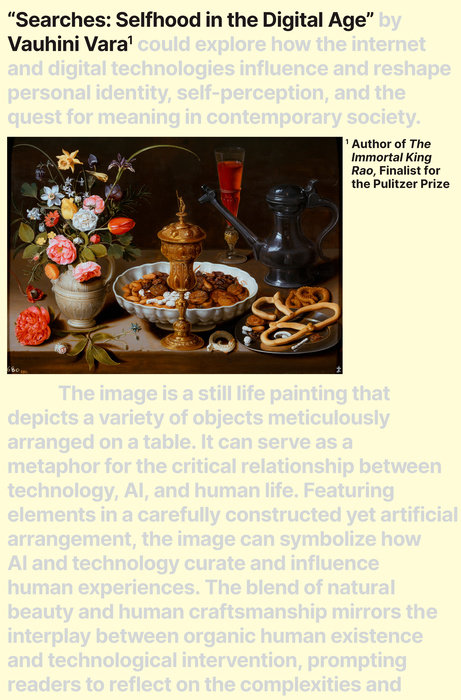
Occasionally, a sociological book comes along that effectively captures the Zeitgeist of people and society within the scope of current events. These books articulate our experience such that we want to read these books. Vauhini Vara’s Searches: Selfhood in the Digital Age (2025) is one of those books.
When I recently saw this title on Publisher’s Weekly, the book’s title made the subject and its’ sociological relevance in today’s digital age immediately self-evident. It wasn’t until the last two to three decades that we could – in the course of human history – find bread crumbs of our own thoughts-experience-lives-searches-postings-etc. (lives!) and the collective experience of everyone who ever goes online (i.e., “everybody,” essentially) “on the internet.” Our individual and collective search histories are cumulatively aggregated online. A dream for sociologists and marketers.
Relevant example #1: When I started reading Searches: Selfhood in the Digital Age, the author self-disclosed that she looked back at her own Google search history over several years and at her Google account. Based on her cumulative search history, Google had accurately figured that she’s a married high-income-earner with a child. Google had also assumed that she works in tech because she does so many searches about the tech industry; in that case, Google was mistaken….. Similarly, many people complain about targeted search engine advertising based on one’s search history (when you search for shoes, your search engine starts showing you advertisements for shoes….) and/or that “Google probably knows where I live…..” Then, there are the less-common tech privacy geeks like me who literally clear my cache and search history between EVERY search. I never get online advertising as there’s no cumulative history for search engines to use to identify my interests or life-trends (although the contours of my life could likewise be privately inferred by scanning the content of my email history…..).
Relevant example #2: When I want to tweak one of my websites to make the content relevant for the people who I want searching for my website, I go to Google Trends and look up society’s collective search histories from 2004 to the present to find which topical words and/or phrases – relevant to my website(s) – people are currently searching. Ditto when I periodically pay for online advertising. Then, I populate my website(s) or advertising with relevant search terms that match what people are searching for so I can make my content relevant to the people with whom I am looking to connect.
I am glad that Vauhini Vara had the insight to write this book (extra bonus: I learned in the book that she and I have lived in several of the same cities). I appreciate having this book be part of our collective reading for sociological naval-gazing.
Bibliophile and would-be-antiquarian Kim Burkhardt reviews books at The Books of the Ages and at The Hermitage Within. If you are a new visitor, it would be great to have you follow this blog (thank you!). If you know someone who would like this blog, please share it with them (thank you!).
The cover of Ravenna M. Helson and Valory Mitchell’s book aptly introduces the book’s topic: A fifty-year study of women’s adult development.
I don’t recall how I found out about this book, but I was happy to find that my local library has the book. I picked up a copy yesterday.
Goodreads’ description of Women on the River of Life: A Fifty-Year Study of Adult Development begins as follows: “Commenced in 1958 with 142 young women who were seniors at Mills College, the Mills Study has become the largest and longest longitudinal study of women’s adult development, with assessments of these women in their twenties, forties, fifties, sixties, and seventies.” (Mills College is a private college in California.)
The first chapters of the book provide what a sociological study must provide – discussion of how the study came to be, an explanation of the study’s methodology, demographics of the study’s participants, limitations of the study (for example, all the study participants were women who could attend a private women’s college – indicating a more homogenous group of people within the study than would typically be found in broader society), an analysis of the social times within which the study occurred, an explanation of the benefits of a longitudinal study over a point-in-time study, etc. Such explanations for sociological studies are necessary, important, and informative.
After I skimmed through the introductory explanations to get a broad sense of the study and its’ parameters, I began happily finding valuable insights from what has been learned in this longitudinal study. For example, when the study leaders did the first series of interviews and had the study participants complete their first set of multiple questionnaires about their lives and about how the study participants socially identify, what goals they had, how their viewed their inner experience, etc. (when the study participants were in their final year of undergraduate study), the study leaders scored each study participant’s “social presence” based on the completed questionnaires. The study leaders wondered if scores of higher or lower “social presence” would impact the women’s adult lives in terms of goal achievement and other life measurements. Over the next several decades, subsequent follow up (questionnaires, etc.) did – in fact – show that higher or lower levels of “social presence” did correlate to life achievements or lack thereof: ability to achieve career goals, rates of marital stability or divorce, etc.
I am finding this book so insightful that reading a library copy isn’t enough. This study’s insights resonate with my own life experience. I see ways in which the sociological insights presented here can help me direct the course of how I navigate the world. I ordered a copy to have on my bookshelf at home.
Bibliophile and would-be-antiquarian Kim Burkhardt reviews books at The Books of the Ages and at The Hermitage Within. If you are a new visitor, it would be great to have you follow this blog (thank you!). If you know someone who would like this blog, please share it with them (thank you!).
The ways through which we travel our faith journey – church attendance, types of prayer, etc. – should nurture our faith journey. If anything we participate in feels as though it is constricting our faith journey, either something is amiss or we are ready for additional or different faith activities. Being attentive to any sense of constriction is an opportunity to look to adapt either ourselves or our situation. It is entirely good when we notice that we need to adjust – we are being attentive in our faith journey (or, sometimes, it is an indication that we simply need to become more engaged). With a new year starting (2026) and with the Christmas season ending soon, this is a good calendar time to consider adding something new as we approach Ordinary Time (starting January 12).
By way of example, I am starting a Master’s in Theology in January (a “Masters in Theology Studies” or “MTS” for lay people rather than a Master’s in Divinity for pastors-in-training). At a recent meeting for registered MTS students, we were provided with the first of our faith formation sessions. We were told that Masters in Theological Studies degrees typically cover four academic subjects – scripture, ethics, systemic theology, and historical theology. In addition to academics, MTS programs – ours, at least – include faith formation of enrolled students – the degree process should include our faith maturation in addition to a focus on academics (a whole person approach). We were instructed to start participating daily in Liturgy of the Hours (Divine Office) – the daily prescribed prayer life of the Church.
In recent years, my prayer life has principally been one of contemplative prayer – both at home and in small prayer groups via Contemplative Outreach. There are as many ways to pray as there are people; contemplative prayer has been personally fruitful for me. In contemplative prayer, I encounter periods of time in which I experience God loving me – which has been freeing me from difficult aspects of “the human condition.” As with anything else, I do also experience occasional dry periods in my experience with contemplative prayer. Therefore, I am now open to also praying Liturgy of the Hours (Diving Office).
Prior to being recently instructed to start participating in Liturgy of the Hours, I viewed the Divine Office remotely (“from afar”) as the prerogative of priests and avowed religious – a respected activity distant from my daily life. When we were recently told to start participating in Liturgy of the Hours, part of me was intrigued. Another part of me was also relieved when we were told that Liturgy of the Hours is “a tool to help us pray, not a straight jacket to keep us from praying.” I am enjoying the journey into the Divine Office.
This daily prescribed prayer life of the Church is the Catholic church’s formal prescribed method for priests, deacons, avowed religious (i..e, nuns, brothers, etc.), and interested lay people to participate in Paul’s instruction for us to “pray without ceasing” (I think several other liturgical denominations also have Liturgy of the Hours?).
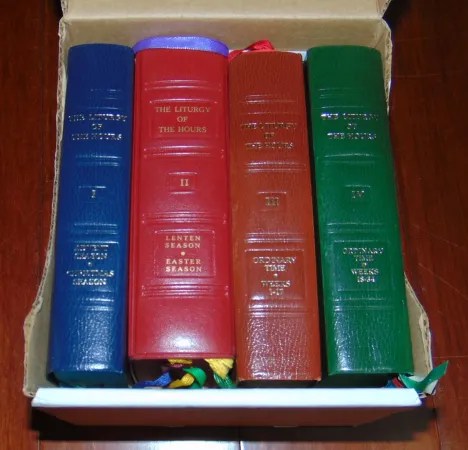
The print version of Liturgy of the Hours – around since 1970 as an outgrowth of Vatican II – is a series of four books with morning, evening, and throughout-the-day prayers for each liturgical season, feast days and Solemnities, and each day of the year. When I brought home a complete set of Liturgy of the Hours, I felt good about undertaking this new project. I was also surprised: finding one’s way to each days’ readings depends upon navigating pages and sections depending upon the liturgical season and assigned readings for specific feast days, holy days, etc. – it’s like navigating a small library’s equivalent of the Dewey Decimal System. No matter – praying the Hours means sharing in the mutual prayer life of everyone worldwide who prays the Liturgy of the Hours. For people who want to “keep it simple,” there are apps that will bring you each day’s readings. For lay people, we have the option of praying only the morning prayers (upon rising) and evening prayers (before going to bed).
A new, updated version of Liturgy of the Hours (Divine Office) – the daily prescribed prayer life of the Church – is the Catholic church’s formal prescribed method for priests, deacons, avowed religious (i..e, nuns, brothers, etc.), and interested lay people (I think several other liturgical denominations also have Liturgy of the Hours?).
The current print version of the Catholic Liturgy of the Hours – around since 1970 as an outgrowth of Vatican II – is a series of four books with morning, evening, and throughout-the-day prayers for each liturgical season, feast days and Solemnities, and each day of the year. When I brought home a complete set of Liturgy of the Hours, I felt good about undertaking this worldwide way of pray-without-ceasing. I was also surprised: finding one’s way to each days’ readings depends upon navigating pages and sections depending upon the liturgical season and assigned readings for specific feast days, holy days, etc. – it’s like navigating a small library’s to find each day’s readings. No matter – praying the Hours means sharing in the mutual prayer life of everyone worldwide who prays the Liturgy of the Hours. For people who want to “keep it simple,” there are apps that will bring you each day’s readings. For lay people, we have the option of praying only the morning prayers (upon rising) and evening prayers (before going to bed).
For anyone aware that avowed religious in monasteries get up at times like midnight and 3:00 or 4:00 am to do Liturgy of the Hours, I recently came upon interesting trivia regarding this practice. While most of us groan at interrupting a good night’s sleep, there’s actually a historical precedent explaining that this night time practice isn’t as difficult as it would seem. Prior to the Industrial Revolution – when night time lighting became available – it was biologically customary for people to sleep in two phases. In this biphasic sleep pattern, people had what Europeans called “first sleep” and “second sleep” – meaning that people would sleep for awhile (“first sleep”), then naturally wake up for an hour or longer and undertake activities before returning to sleep for “second sleep.” An interesting BBC article (available here) discusses this historical biphasic sleep pattern. Therefore, the monastic habit of a during-the-night portion of Liturgy of the Hours blends naturally with humanity’s historically-normal sleep patterns.
Bibliophile and would-be-antiquarian Kim Burkhardt reviews books at The Books of the Ages and at The Hermitage Within. If you are a new visitor, it would be great to have you follow this blog (thank you!). If you know someone who would like this blog, please share it with them (thank you!).
Book lovers like to “know our options” for book purchasing. Therefore, I dedicate this blog post to profiling several options for ordering books.
Independent Book Stores
Supporting small, local businesses is important for the health of our communities. Browsing a bookstore is good for the soul and brings us into conversation with fellow book lovers.
My personal favorite local bookstore is Village Books in my hometown of Bellingham, Washington. Village Books creates community for local residents via their engaging, locally-loved bookstore and coffee shop. They will help book seekers “find any book that exists.” They also support local authors – they carried a couple of books that I self-published (thank you!).
The website “Independent Bookstores.ca” lists indie bookstores across Canada. This website is a great resource!
I currently live in Greater Seattle, so I would be remiss for not mentioning Seattle indie bookstore Elliott Bay Books. Because Seattle is a dog-loving city, dogs are welcome at Elliot Books. Every dog that comes in the door with a book reader gets their photo posted on Elliott Bay Book’s Instagram feed (I really should take my cat in to see if they’ll take her photo!).
National Bricks-and-Mortar Bookstores
In-person bookstores are important. Supporting brick-and-mortar stores are good for the economy. Again, browsing a bookstore is good for the soul and brings us into conversation with fellow book lovers. I buy from Barnes and Noble in the U.S.
Online and/or magazine-based book retailers (alphabetical):
Abe Books. Based in Victoria, B.C. – with an additional office in Munich, Germany – Abe Books has been selling discount books online since 1996. They also sell fine art and collectibles. I bought a few books from them in my earliest days online. My favorite reason for liking Abe Books is that they are Canadian!
Hamilton Books. Hamilton Books is based in Connecticut, USA and has been around since 1969. They specialize in selling discounted books to U.S. customers. I love Hamilton Books. They sell books via their website and a print magazine. I discovered them more than twenty years ago when they somehow got my name and mailing address; they sent me one of their magazines listing a sampling of their book inventory (I was living in B.C. and drove weekly to check my Washington State mail box where I received my U.S. mail). It was actually their magazine that I fell in love with – their listing of quirky and off-the-wall titles of available books. I started buying from them for the purpose of staying on their mailing list (this is a sentence that every marketer wants to read!). Reading their lists of “off-the-wall titles” – such as “off the beaten track” historical books and books on political and religious conspiracy theories from “every end the political and religious spectrums” – literally became Friday night entertainment for me. I actually have a stack of their magazines to give my book-loving friends. One of the books I ordered from Hamilton Books was written by a church minister who “made the case” that the Gospel of Mark was written by an astrologer (The Gospel and the Zodiac) – my curiosity wanted to know what the minister had to say…..
Thrift Books (their marketing angles: “gift more, spend less” and “read more, spend less”). This Washington State-based bookseller calls themself “the largest online independent used book seller” and state that they opened in 2003. A friend told me about Thrift Books last spring; I have already purchased enough books to achieve their highest reader/purchaser tier of “Literati Elite.” Their “membership tier” (“Reading Rewards”) program is simple yet fun – the more you buy, the more book-buying benefits you get….. Their membership tier program seems to be tied into our digital age approach to tapping dopamine receptors – our brains get a “dopamine high” every time we “like” or “achieve” something online via a click-of-the-mouse….. Of course, book lovers like joining “Literati Elite” status…… For every-so-many-dollars-spent, a book buyer qualifies for a free book “up to an X dollar amount” (just pay for shipping) – I’m using this member benefit to order books I want to give friends [in case you’re wondering what I’m gifting to my book-loving friends, I’m currently collecting shipping-only copies of The Gentleman from Finland (a book from a Seattle travel writer that made me laugh so hard I cried) and The Shadow of the Wind (opposite response – this novel based in 1945 Barcelona actually sent me into a dark, downward emotional tailspin but this NYTimes bestseller was so well written that I had to finish it. I am looking forward to when I’ve forgotten enough of the book to read it again)].
Encyclopedic Book Listings
Amazon-owned Goodreads provides a book equivalent to the Internet Movie Database (IMDB), listing a very broad listing of books and providing a profile of each book. A straightforward way to find – and find out about – books.
Bibliophile and would-be-antiquarian Kim Burkhardt reviews books at The Books of the Ages and at The Hermitage Within. If you are a new visitor, it would be great to have you follow this blog (thank you!). If you know someone who would like this blog, please share it with them (thank you!).
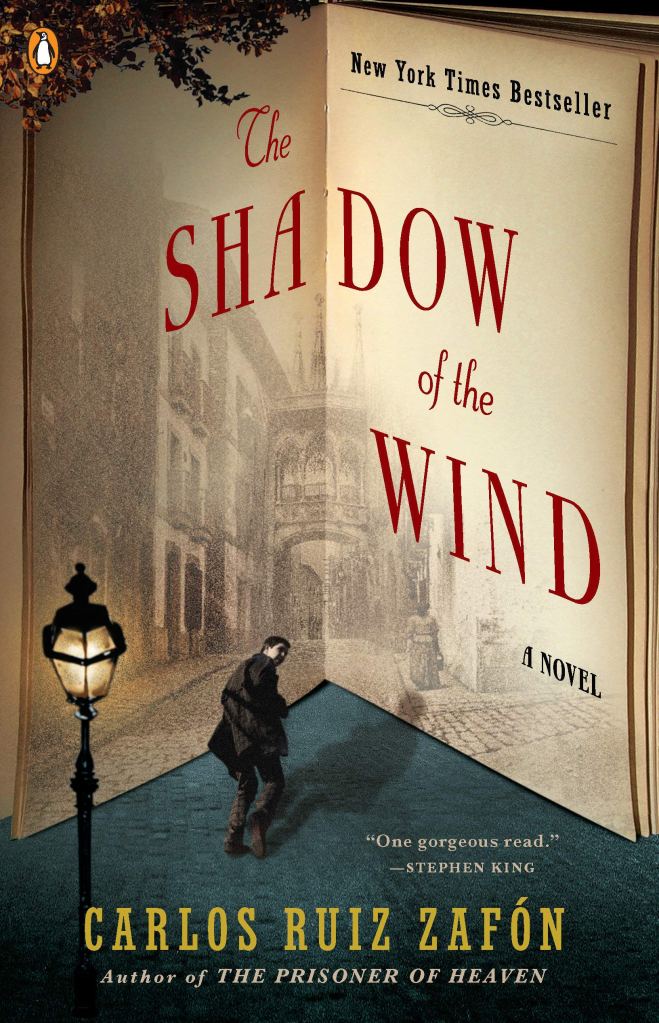
I came upon Carlos Ruiz Zafon’s The Shadow of the Wind during COVID. I was out walking one day (alone, of course, there was a pandemic on….) and stopped at a Little Free Library in North Seattle. I went home with a whirlwind of a psychological thriller that captivated my imagination for weeks.
The Shadow of the Wind is set in Barcelona in 1945. This novel is wonderfully about books. And about people. And Barcelona. And, psychological suspense.
In this book, the writer manages to keep much in “the shadows” throughout the book – no way to “catch the whodunnit.” We are taken on the wind through the suspense of plot. Bottom line, Carlos Ruiz Zafon knows how to write.
This novel is dark. I attest to the author’s ability to write – the novel’s darkness took me into the depths of a dark despair. However, I couldn’t put the book down. When I had started reading a different book (several years earlier) that also led me into the depths of despair, I donated that other book to the library to get it out of my house rather than continue reading it. This book, however, doesn’t provide that option. I was so emotionally drawn into the book that I had to continue reading it. When I got to the end of the book, I was glad to have read it.
I’m looking forward to when I’ve forgotten enough details of the book that I can read it again. When I read it again, I’m going to be prepared for the depths to which the book takes the reader. The Shadow of the Wind is a must-read.
Bibliophile and would-be-antiquarian Kim Burkhardt reviews books at The Books of the Ages and at The Hermitage Within. If you are a new visitor, it would be great to have you follow this blog (thank you!). If you know someone who would like this blog, please share it with them (thank you!).
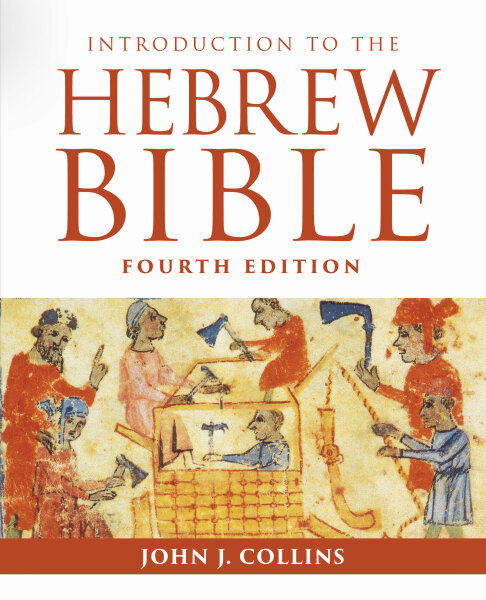
I am reading John J. Collins’ book Introduction to the Hebrew Bible (Fortress Press) for a graduate course on the Hebrew Bible (Old Testament).
This is book for highly educational. The book itself is informative – I am learning a great deal about the historical, social, religious, and geographic contexts of the Near East.
The book’s contents are dense enough that I am regularly taking time to pause for reflection. I am now able to discuss the North and South kingdoms of Israel and Judah, for example, while being able to explain how Judaism and Christianity each came to call the first five books of the Hebrew Bible the Torah and the Pentateuch respectively. I looked up and printed out several maps to become more familiar with the geographic region of the Bible.
I was already aware – before reading this book – that recent Biblical scholarship thinks of several groups of writers for sections of the Hebrew Bible – the “E,” “D,” “J,” and “P” (priestly) sources. It’s interesting to read again about the academic theories about these various groups of writers.
This book is a great resource for anyone who wants to better understand the Hebrew Bible. In my case, I have previously read the Hebrew Bible and New Testaments – from the first page of Genesis to the final page of Revelations. I also took an undergraduate course from a rabbi on “The History and Culture of Ancient Israel.” Reading the entire Old and New Testaments and taking an undergraduate course before starting this book were both helpful in being able to take in the content of the Introduction to the Hebrew Bible.
The author taught at Yale Divinity School.
Bibliophile and would-be-antiquarian Kim Burkhardt reviews books at The Books of the Ages and at The Hermitage Within. If you are a new visitor, it would be great to have you follow this blog (thank you!). If you know someone who would like this blog, please share it with them (thank you!).
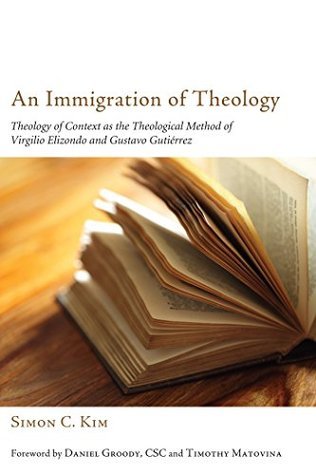
I recently came upon An Immigration of Theology by Fr. Simon Kim and am intrigued with what the author has done with this book.
Goodreads summarizes this book, in part, with the following: “The theological reflections of Virgilio Elizondo and Gustavo Gutiérrez are examples of the ecclesial fruitfulness of the second half of the twentieth century. Following the directives of Pope John XXIII and the Second Vatican Council, [they] present the Gospel message in relevant terms to their own people…. Inspired by this moment in Church history, while at the same time recognizing the plight of their people….. [they] discovered a new way of doing theology by asking a specific set of questions based on their local context. By investigating where God is present in [their local context], both theologians have uncovered a hermeneutical lens in rereading Scripture and deepening our understanding of ecclesial tradition…. a theological method that takes seriously the contextual circumstances of their locale. By utilizing the common loci theologici of Scripture and tradition in conjunction with context and their own experience, [they] illustrate…. how every group must embrace their own unique theological reflection.”
I find this interesting – there seems to be the option in this book of stating that we must make theological concepts relevant to our own circumstances while also stating that theological principles are universal. What I am hoping to read in this book – now that I have it sitting on my coffee table – is that theological principles are universal in principle and also local in adaptation.
Bibliophile and would-be-antiquarian Kim Burkhardt reviews books at The Books of the Ages. If you are a new visitor, it would be great to have you follow this blog (thank you!). If you know someone who would like this blog, please share it with them (thank you!).


 The Books of the Ages