Book Review: Healing as a Parish Ministry
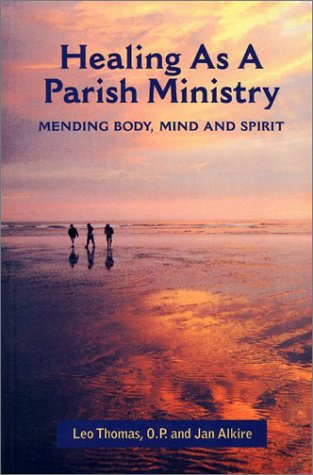
I was happy to stumble upon this book in a Little Free Library and to then discover that this practical and helpful book was locally written (i.e., Seattle, Washington).
The summary of this book on Goodreads states: “Jesus’ mandate to heal the sick is beginning to enter into faith communities today. In this sound and practical book, Father Leo Thomas and Jan Alkire show how this vital ministry is rooted in Christian scriptural and sacramental tradition. Pastors and lay leaders will benefit from the authors’ faith-filled, balanced wisdom. ‘Healing as a Parish Ministry’ will help all who read it become more effective channels of Christ’s healing to those who are hurting.”
Jesus healed the sick during his time on earth. Jesus instructed his disciples to heal the sick. Pope Francis talks today about the church being a “field hospital.” In a workshop I’m taking through Franciscan University’s Catechetical Institute, the instructor talks about church-goers sometimes preferring to go to their pastor/church for help before going to mental health providers. The message is communicated in many ways that church is meant to be a place where people can come for healing and direction. This book – Healing as a Parish Ministry – provides practical, front-line instruction to parishes – local churches – on how to provide healing ministries at one’s church.
In their book Healing as a Parish Ministry:
- Leo Thomas and Jan Alkire write about faith healing does not mean curing natural consequences of what happens in life; rather, that faith healing is often about bringing us into the fullness of who God wants us to be – a very healing experience!
- Thomas and Alkire write about how to set up a parish healing ministry – and why it is important.
- The authors provide useful resources on how to connect meaningfully and usefully with parishioners who are in a time of need. Of equal importance, they also provide practical tips on what NOT to do so as to avoid alienating parishioners or causing ill will.
I read this book as a person who has found healing in church and who wants healing to be something that happens for many people in church. In my case, I returned to church – after a time away – with a painful neuropathic medical condition. That condition includes a hyper-stimulated sympathetic nervous system and associated physical pain. After returning to church, I found that contemplative prayer (and yoga, in my case) slowly calmed my over-stimulated nervous system – resulting in a reduction in physical pain. When I later came upon this book, I found that the book speaks to the type of healing I’ve experienced – I see the book having practical and real – real-world – insights and application.
This book is a great resource! I recommend this book to anyone who wants churches to be a place of healing.
Kim Burkhardt blogs at The Books of the Ages and A Parish Catechist (and a “Content Creator/Individual” member of the Association of Catholic Publishers). If you are a new visitor, it would be great to have you follow this blog (thank you!). If you know someone who would like this blog post, please share it with them (thank you!).


 The Books of the Ages